

How Motorized Louvered Roofs Work: Bioclimatic Pergola Technology
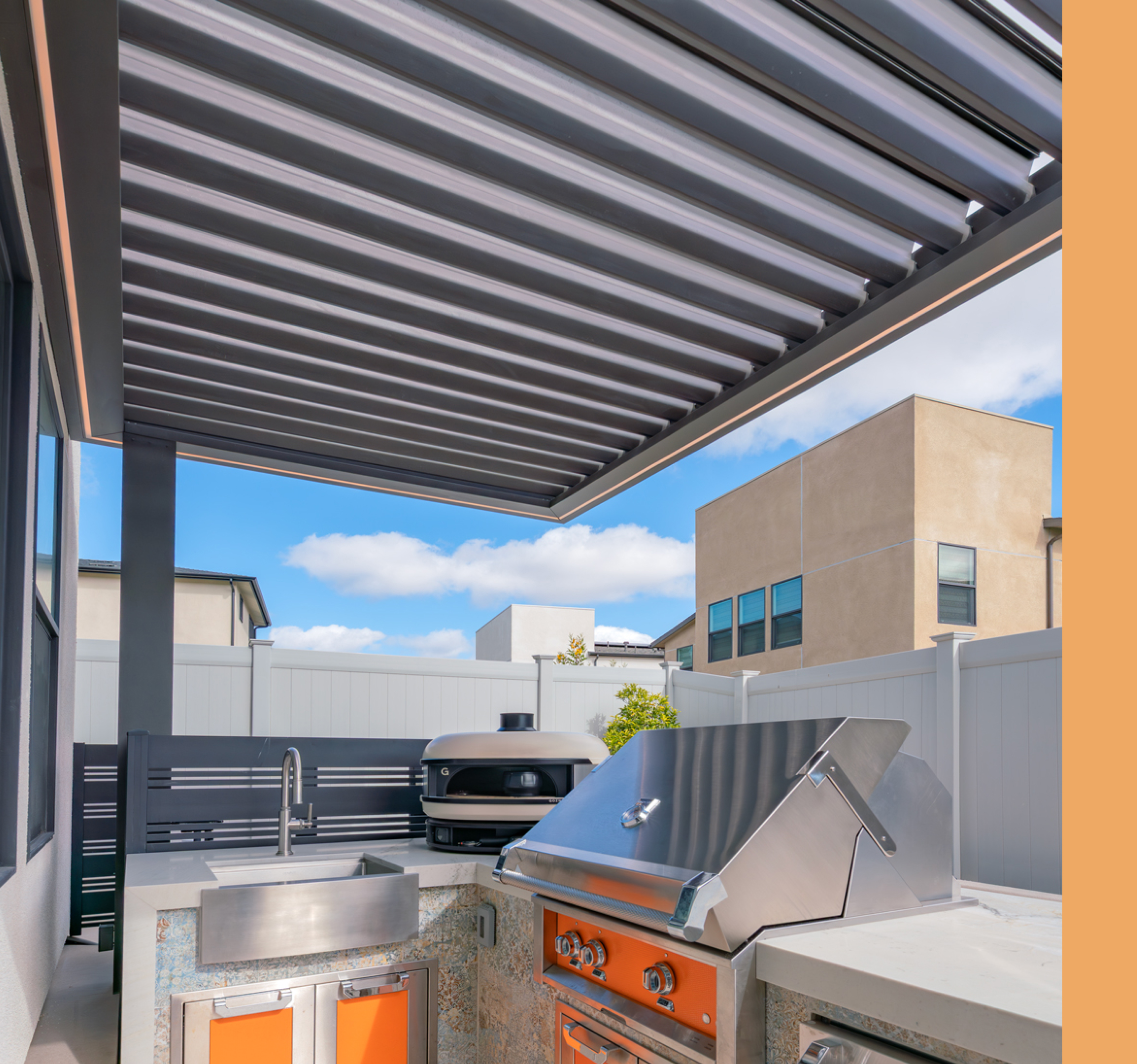
A motorized louvered roof works by rotating a series of interlocking aluminum blades until they seal against each other, channeling any rainwater into hidden gutters and routing it away through the support posts, all controlled by a wall switch, a phone app, or a built-in weather sensor. This louvered roof mechanism turns a single roof into a system that actively adapts to San Diego’s sun, wind, and rain instead of sitting overhead as a fixed structure. The result a homeowner actually notices is simpler than the engineering behind it: dinner stays outside when the marine layer rolls in.
This guide walks through that mechanism directly: how the louvers close watertight, what separates extruded aluminum louvers from roll-formed ones, how app control and automation actually work, and how the same system regulates temperature underneath. If you are comparing louvered patio covers against a solid or lattice roof, understanding the engineering behind the “smart” claim is what separates a feature from a system you can rely on for years.
What Is Bioclimatic Pergola Technology?
Bioclimatic pergola technology is an automated outdoor shading system that uses motorized, interlocking aluminum louvers to actively adjust light, airflow, and rain protection in response to real-time weather conditions. The term comes from bioclimatic architecture, a design approach that shapes a structure around the climate it sits in instead of sealing that climate out.
Unlike a fixed solid roof or an open lattice pattern, a bioclimatic pergola’s roof rotates. Angling the aluminum louvers partway open lets in filtered light and cross-breeze. Rotating them fully closed creates a solid, watertight surface.
Soltech’s louvered systems apply this same principle so a San Diego homeowner gets one roof that functions as an open-air pergola on a clear afternoon and a fully enclosed patio cover during a winter storm. If the category distinctions are still blurry, our guide to the difference between a pergola and a patio cover sorts out where each structure sits.
Three outcomes define the category. Microclimate control means adjusting the immediate outdoor environment rather than the whole property. Weather responsiveness means the system reacts to sun, wind, and rain without manual intervention. Thermal comfort means keeping the space beneath the roof at a usable temperature. The first is what bioclimatic architecture targets; the other two are what a homeowner experiences day-to-day.
How Do Louvered Roofs Become Waterproof When Closed?
A motorized louvered roof becomes waterproof through four connected mechanisms: louver rotation, seal engagement, gutter channeling, and post drainage. Each one closes a specific gap where water could otherwise get through, which is why the louvered roof waterproof mechanism works as a chain rather than as a single feature.
Water moves through four handoffs before it reaches the ground:
- Louver rotation: The motor rotates each aluminum louver to a fully closed, flat position, eliminating the open gaps that exist when the roof is angled for airflow.
- Interlocking seal engagement: As the louvers reach the closed position, an interlocking louver seal, a gasket built into the edge of each blade, presses against the adjacent louver to close the seam between them.
- Gutter channeling: Water landing on the closed roof runs off each louver’s slope into a gutter integration system built into the frame, rather than dripping straight through the structure.
- Post drainage: The gutters route collected water into the hollow support posts and down to a ground-level drainage point, keeping water off the patio surface entirely.
When fully closed, the louvers interlock tightly to form a continuous, weather-tight barrier across the roof. Rainwater falling on the closed surface is directed along engineered channels built into each louver blade into the surrounding perimeter gutter network, preventing drips and keeping the living space below dry.
Every louvered roof we install in San Diego depends on all four structural mechanisms working together, from residential backyard patios to commercial poolside cabanas, because a weatherproofing system that addresses only three of the four failure points will still allow water to penetrate. Our project portfolio shows how that plays out across very different rooflines, spans, and site conditions.
What Is the Difference Between Extruded and Roll-Formed Aluminum Louvers?
Extruded aluminum louvers are formed by pushing heated aluminum through a shaped die, producing a thicker, denser blade, while roll-formed aluminum louvers are bent from thinner sheet stock on rolling equipment, producing a lighter, less rigid blade. Window and door manufacturer Marvin, which uses extruded aluminum across its clad product lines, documents that extruded aluminum is thicker and more dent-resistant than roll-formed, and that thinner roll-formed stock does not deliver the same structural performance.
| Attribute | Extruded Aluminum | Roll-Formed Aluminum |
|---|---|---|
| Manufacturing process | Heated aluminum billet pushed through a die | Aluminum sheet bent through a series of rollers |
| Relative thickness | Up to roughly three times the thickness of typical roll-formed stock | Thin-gauge sheet, closer to coil stock thickness |
| Strength and load characteristics | Thicker wall profile, higher resistance to bending | Thinner gauge, more flexible under load |
| Finish performance | Formed first, then coated, supporting AAMA 2605 qualified finishes | Typically prefinished coil, more prone to finish cracking at bends |
| Typical use case | Structural louver blades, load-bearing frame members | Lightweight trim, decorative panels, lower-load components |
| Production economics | Higher tooling investment, suited to custom profiles | Lower per-unit outlay at high production volumes |
For a motorized louvered roof, blade rigidity matters more than it does for a static frame member. A louver that flexes under wind load can bind against its seal or its neighboring blade, and a bound louver is a louver that will not seal.
While traditional lattice and solid patio covers are available in both roll-formed and extruded aluminum options depending on span and specification, motorized louvered roofs are engineered exclusively with heavy-gauge extruded aluminum. Extruded aluminum provides the structural rigidity, tight tolerances, and torque resistance necessary for rotating louvers to seal flush and operate smoothly over long spans.
Soltech designs and installs custom louvered pergolas utilizing architectural-grade, extruded aluminum systems engineered by industry-leading luxury manufacturers, including 4K Aluminum and premier bioclimatic system partners. Our overview of the benefits of aluminum patio covers explains why the material holds up in coastal air across every product line we build.
If you are still weighing materials at the category level rather than at the blade, our breakdown of wood versus aluminum patio covers covers those tradeoffs first.
Can You Control a Louvered Roof From Your Phone?
Yes, motorized louvered roofs can be controlled from a phone app, and most systems also close automatically through built-in weather sensors without any manual input. App control lets a homeowner adjust louver angle, open or close the roof fully, and in many installs, adjust integrated lighting from wherever they are standing on the property or inside the house.
Weather sensors handle the moments a homeowner is not reaching for their phone. Rain and wind sensors mounted on the frame detect a sudden shower or a wind gust past a set threshold and rotate the louvers closed automatically. That is the mechanism protecting your patio furniture on a Tuesday afternoon while the house is empty.
Motorized pergola motor types fall into two categories. Tubular motors run quieter and remain concealed within the structural beam, making them a popular choice for sleek residential louvered pergolas. Linear actuators, by contrast, are typically utilized on commercial-grade structures or wider spans where additional pushing torque is required to operate heavier louver assemblies.
Smart pergola automation is only as reliable as the wiring behind it. Soltech keeps a dedicated electrical specialist on staff specifically for patio cover installs, wiring the motor, sensors, and any integrated lighting as one coordinated system rather than as an add-on bolted onto a standard install. For a fuller look at what motorization changes, compare manual versus motorized louvered patio systems.
How Does a Bioclimatic Pergola Regulate Temperature?
Bioclimatic pergolas regulate temperature by adjusting louver angle to control how much direct sunlight and airflow reach the space underneath, rather than by insulating against heat the way a solid roof does. The roof is not fighting the heat. It is managing where the heat goes.
Angling the motorized louvers to a partially open position blocks direct, overhead solar radiation while maintaining an open channel for warm air to rise and escape. This continuous cross-ventilation creates a natural cooling effect beneath the structure, significantly reducing ambient temperatures on your patio during peak afternoon sun.
A bioclimatic pergola makes that adjustment differently across a single San Diego day. At two in the afternoon, closing the louvers most of the way blocks direct sun and delivers shade close to what a solid roof provides, while a narrow gap still lets rising heat vent out instead of building up underneath. By seven in the evening, opening the louvers fully restores the open-air feel of a standard pergola, and the sky comes back.
This is the functional difference between a bioclimatic pergola and the alternatives. A solid patio cover makes that trade-off once and for all: full shade, no airflow adjustment. A lattice cover makes the opposite tradeoff, with constant airflow and partial shade that never closes against rain. A louvered roof lets a homeowner make that tradeoff differently every day, or lets the weather sensors make it automatically. We install these systems throughout the areas we serve, from coastal properties north to Oceanside down through the South Bay.
Key Takeaways
- Bioclimatic pergola technology uses motorized, interlocking aluminum louvers to actively adjust light, airflow, and rain protection in response to real-time weather rather than holding one fixed position.
- Waterproofing depends on four connected mechanisms: louver rotation, interlocking seal engagement, gutter channeling, and drainage routed through the hollow support posts. Address three and water still gets through.
- Extruded aluminum is the structural requirement for louver blades, running up to roughly three times the thickness of typical roll-formed stock and delivering the rigidity a rotating blade needs to seal flush over a long span.
- App control and weather sensors work together. You adjust the roof from your phone; rain and wind sensors close it when you are not there.
- Motor selection follows the span. Tubular motors stay concealed and run quietly on residential pergolas, while linear actuators supply the extra torque wider commercial-grade spans require.
- Temperature regulation is a daily adjustment, not a fixed condition. Partially open louvers block overhead sun while venting warm air, which is the tradeoff a solid roof cannot make.
Ready to See It Over Your Own Patio?
A louvered roof is the kind of system you understand best standing underneath one, watching the blades close. Soltech has been building outdoor spaces across San Diego County for more than 20 years, with full-time employee crews, in-house electrical expertise, and no subcontractors on any job site. Licensed sheet metal contractor C-43-830212.
Schedule your free, at-home design consultation and we will walk your space, take the measurements, and show you what the roof would actually look like over it.


